

2025 WASSCE Candidates Will Fail Core Mathematics If…. – WAEC Chief Examiner’s Report
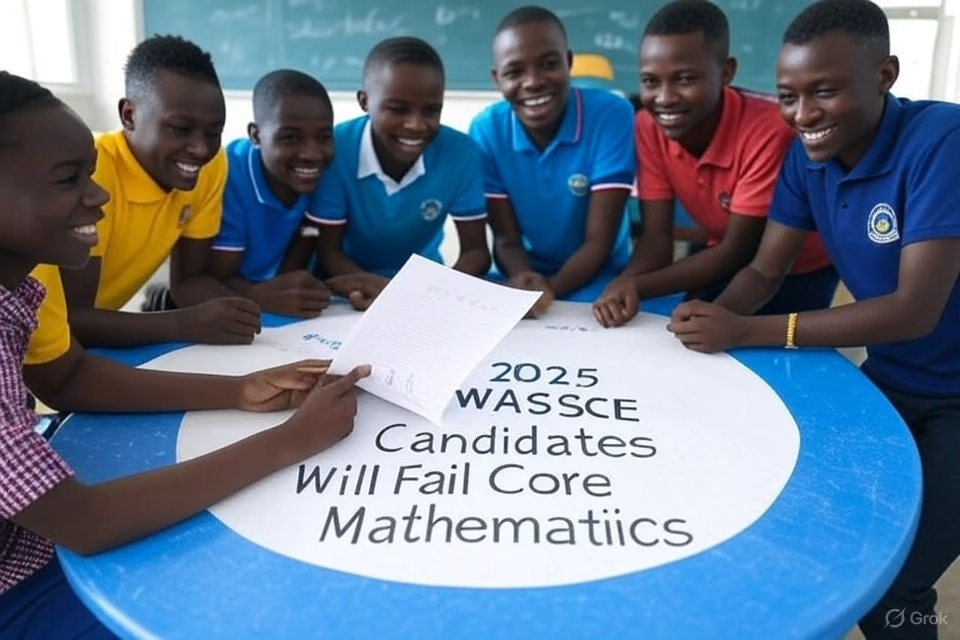
- The WAEC Chief Examiner’s Report has unearthed weaknesses of 2024 WASSCE Core Mathematics candidates that 2025 candidates must avoid.
- The report paints a bad picture and shows candidates are not fully ready and teachers do not teach some aspects of the syllabus well.
- More students are likely to fail in subsequent examinations if care is not taken.
Mathematics, particularly Core Mathematics, continues to be one of the most challenging subjects for many students sitting the West African Senior School Certificate Examination (WASSCE). While the 2024 WASSCE results revealed some strengths among candidates, the weaknesses identified by examiners highlight critical gaps that future candidates must address if they do not want to fail. In this blog post, we explore these challenges in detail and offer practical recommendations to help 2025 WASSCE candidates improve their performance in Core Mathematics.
Strengths Shown by Candidates
Before diving into the weaknesses, it’s important to acknowledge the areas where candidates performed well:
Trigonometric Ratios: Many students successfully solved problems involving sine, cosine, and tangent. This shows a good grasp of using these ratios to find unknown sides and angles in right-angled triangles.
Bearings: Candidates were generally able to solve problems requiring them to interpret and calculate bearings — an essential skill in navigation and mapping.

Probability: Students demonstrated strong understanding in calculating the probability of events, whether simple or compound.
Concept of Mean: Candidates effectively applied the concept of mean to solve various problems, indicating a solid foundation in basic statistics.

These strengths suggest that when concepts are well taught and practised consistently, candidates are capable of achieving high performance. However, the weaknesses identified also highlight crucial areas that require urgent attention.
2025 WASSCE Candidates Will Fail Core Mathematics if They Do Not Act on this WAEC Chief Examiner’s Report Which Highlights The Major Weaknesses of Core Mathematics Candidates
1. Representing Mathematical Illustrations in Diagrams
One of the most notable weaknesses is the inability of candidates to represent mathematical information in diagrammatic form. Many students struggle to translate word problems into visual representations such as graphs, sketches, and geometrical figures. This skill is vital because a well-drawn diagram often makes a problem clearer and easier to solve.
Why this matters: Mathematics is not just about numbers; it is also about visualising relationships and structures. Being able to draw and interpret diagrams is critical for success in topics like geometry, mensuration, and vectors.
2. Solving Global Mathematics-Related Problems
Candidates also showed poor performance in “global mathematics” problems — questions that integrate multiple concepts and require comprehensive reasoning. Instead of compartmentalizing problems into smaller, manageable parts, many students attempted to memorize steps without understanding the underlying principles.
Why this matters: Real-world mathematical problems often do not come in a straightforward format. Candidates must learn to connect various topics to solve complex problems effectively.
3. Translating Diagrams into Mathematical Statements
While some students struggle to draw diagrams, others fail to interpret given diagrams into mathematical equations or statements. This shows a lack of analytical skills and conceptual understanding.
Why this matters: In mathematics, especially in topics like coordinate geometry and mechanics, diagrams are the bridge to forming equations that can be solved. Failing to make this connection means candidates lose marks on otherwise solvable problems.
4. Problems on Mensuration
Mensuration, which deals with the measurement of shapes and figures (area, volume, surface area, etc.), remains a major stumbling block. Many candidates find it difficult to recall and apply the correct formulas or to decompose complex shapes into simpler parts for calculation.
Why this matters: Mensuration is not only an examination topic but also a life skill. Understanding how to calculate areas and volumes is essential in fields such as architecture, engineering, and everyday problem-solving.
5. Problems in Business Mathematics
Finally, questions involving business mathematics — such as calculating profit and loss, simple and compound interest, and depreciation — posed significant challenges to many candidates.
Why this matters: Business mathematics equips students with skills relevant to personal finance, entrepreneurship, and many career paths. Weakness in this area indicates a gap in practical numeracy skills needed beyond school.
Recommendations for Future Candidates
Having examined the weaknesses, let us now turn to practical steps candidates can take to improve.
1. Strengthen Diagram Skills
Students must practise drawing accurate diagrams from word problems and vice versa. Teachers should encourage students to visualize problems and use diagrams in every applicable topic. Regularly practising past questions that require diagrams can help candidates develop confidence.
2. Develop Analytical and Integrated Thinking
Rather than memorising isolated formulas, students should focus on understanding how different mathematical concepts relate. Teachers can support this by designing activities that combine different topics, such as using mensuration in probability or integrating geometry with trigonometry.
3. Focus on Conceptual Understanding
Candidates should be encouraged to ask “why” and “how” rather than just “what”. Understanding the reasons behind mathematical procedures enhances retention and makes it easier to apply knowledge in unfamiliar contexts.
READ: 2025 WASSCE Projected Topics for All Subjects
4. Intensive Practice in Mensuration
Given the persistent challenges in mensuration, it is important for students to dedicate time to learning and revising formulas, solving a variety of problems, and practicing breakdown of complex figures. Visual aids, models, and real-life examples can make learning mensuration more concrete and less abstract.
5. Mastery of Business Mathematics
Students must realise the importance of business mathematics and treat it with equal seriousness. Solving practical problems related to savings, loans, investments, and taxation should be incorporated into classroom activities to make learning more relatable.
6. Use of Past Questions and Marking Schemes
Consistent practice with WASSCE past questions helps students become familiar with the exam format and the examiner’s expectations. Reviewing marking schemes also allows students to understand how marks are awarded and identify common mistakes to avoid.
READ: 2024 WASSCE Social Studies Examiners Report: Shocking Lessons for 2025 Candidates
7. Group Discussions and Peer Teaching
Learning in groups can be a powerful tool. Explaining mathematical concepts to peers helps solidify one’s own understanding. Group discussions can also expose students to different problem-solving approaches.
8. Engage with Additional Resources
Candidates should make use of textbooks, online resources, tutorial videos, and educational apps to reinforce classroom learning. Diverse sources present concepts in different ways, increasing the chances of understanding.
While there is evidence of significant strengths among WASSCE Core Mathematics candidates, especially in trigonometry, probability, and mean, the weaknesses in diagram work, global mathematics, mensuration, and business mathematics pose major obstacles to overall success. Future candidates must adopt a strategic approach, focusing on conceptual understanding, practical applications, and consistent practice.
By addressing these weaknesses head-on and following the recommendations above, candidates can greatly improve their performance and approach the WASSCE with confidence. Mathematics does not have to be a stumbling block; with the right mindset and preparation, every student can excel.
Discover more from
Subscribe to get the latest posts sent to your email.
 WASSCE 2025 Final Timetable For General Science Students
  WASSCE 2025 English Language Sample Essay Questions
  WAEC Announces Date to Release May/June 2025 WASSCE Exam Results
  WAEC WASSCE Grading System and Interpretation
  2025 WASSCE Social Studies Questions To Watch (Part 1)
  2025 WASSCE English Language Questions: Sample Essay Topics
  Universities That Will Take You in Without JAMB UTME
  Major Breaking: Two Nalerigu SHS Students Killed In Deadly Attack