

Pupils Report Card Guide For Teachers: Give parents the best report
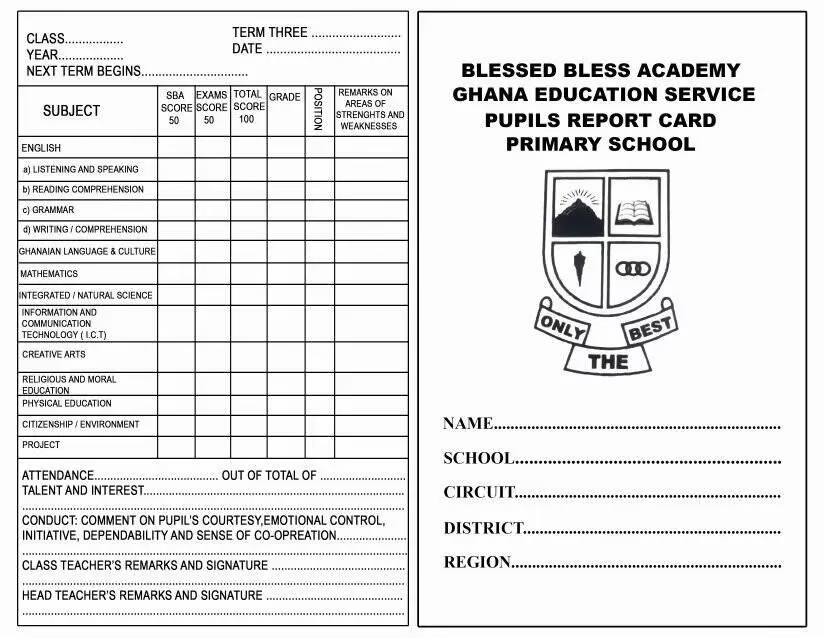
At the end of every term or academic year, teachers are tasked with filling out pupil’s report cards. This task requires providing information that not only vividly describes their learners but also communicates valuable insights to parents.
While filling out report cards has been a long-standing practice in the teaching profession, not every teacher has mastered this skill. Many struggle each term to complete the relevant portions of their report cards effectively. It can be challenging to determine the correct grades, describe a pupil’s attitude, interests, and conduct, and phrase comments in a way that is constructive and not offensive to parents. This demands experience, practice, and a good understanding of each student’s behaviour, academic work, and interests.
Teachers should be meticulous when completing report cards. It is essential to check and cross-check spelling, grammar, and the scores entered. It is advisable to first use a pencil to enter the information and then finalize it with a pen.
This guide has been published to help teachers produce the best pupil’s report cards with the right information, written the right way.

Key Features of a Quality Report Card
1. Use Positive and Constructive Language Use ethical language to communicate both positive and negative feedback. This ensures that the learner’s weaknesses are communicated respectfully to the parent.
- Instead of this: “Ama is not making progress in her English language.”
- Say this: “Ama can improve her performance in the English language by focusing on daily reading and practicing her spelling.”
2. Offer Useful Suggestions As a teacher, you have observed the learner for at least a term. Your comments should suggest specific ways the learner can improve or what support is needed.
- Example: “Ama would benefit from a quiet space and consistent support at home to complete her homework.”
3. Avoid Accusatory or Negative Labels Focus on behaviour and progress rather than applying negative labels. Your feedback should be aimed at solutions.
- Avoid this: “Ama is a very lazy pupil. She is always fighting.”
- Say this: “Ama is making a conscious effort to manage her temperament and interacts more positively with her peers. We encourage continued support at home to reinforce this progress.”
- Alternatively: “Ama is learning to work on her patience and self-control in class. She is encouraged to continue this positive development.”
Grading Systems and Sample Comments
Report Card Grading System for Basic School (Grade 1-6)
Teachers can use the following range of scores to grade their learners. Schools can adapt or expand these ranges to fit their internal policies.
- 80-100% = Excellent
- 70–79% = Very Good
- 60-69% = Good
- 45-59% = Pass
- 35-44% = Weak
- Below 35% = Very Weak
Editor’s Note: The original “35 and below = every week” was corrected to “Below 35% = Very Weak” to fix the typo and create a logical, non-overlapping scale.
Report Card Grading System for JHS (Grade 7-9)
The following is a standard grading system for Junior High Schools.
- 80-100% = Grade 1 (Highest)
- 70-79% = Grade 2 (Higher)
- 60-69% = Grade 3 (High)
- 55-59% = Grade 4 (High Average)
- 50-54% = Grade 5 (Average)
- 45-49% = Grade 6 (Low Average)
- 40-44% = Grade 7 (Low)
- 35-39% = Grade 8 (Lowest)
- 0-34% = Grade 9 (Fail)
Sample Comments for Teachers
Sample Attitude Comments These comments describe a learner’s behaviour and disposition in the school environment.
- Hard-working and diligent.
- Shows great enthusiasm for learning.
- A responsible student who leads with initiative.
- Active and engaged during class activities.
- Always ready and willing to work.
- Enjoys being challenged with new tasks.
- Respectful and friendly towards peers and teachers.
- Shows inconsistency in focus; can be easily distracted.
- Could apply himself/herself more consistently.
Sample Interest Comments These comments should be specific and highlight a learner’s passions.
- Shows a strong interest in visual arts and drawing.
- Is a talented musician with a good sense of rhythm.
- Excels in sports, particularly in track and field events.
- Has a natural aptitude for Mathematics.
- Enjoys drumming and cultural dance.
- Is passionate about drama and team sports.
- A strong debater and enjoys school quizzes.
- Loves hands-on activities and practical science experiments.
Sample Conduct Comments These comments reflect a student’s behaviour and interaction with others.
- Respectful and cheerful.
- Humble and calm, though sometimes too quiet.
- Approachable and supportive of classmates.
- Helpful and cooperative.
- Is learning to interact more positively with colleagues.
- Struggles with regular attendance.
- Can be headstrong and requires firm guidance.
- Shows improvement in respecting classroom rules.
General Concluding Comments
- Keep up the excellent work!
- Has shown significant improvement this term.
- Could do better with consistent effort.
- There is more room for improvement.
- A pleasure to have in class.
Discover more from
Subscribe to get the latest posts sent to your email.
 Universities That Will Take You in Without JAMB UTME
  Major Breaking: Two Nalerigu SHS Students Killed In Deadly Attack
  Bawku SHS Closes Down After a Final Year Student Was Shot Dead on Campus
  2025 WASSCE: GES Warns Against Cheating, Sends Best Wishes to Candidates
  ASUU Awards Scholarships To Students In Ibadan Amid Alleged Maltreatment News
  University Students Involved In Fatal Accident, One Dead, Several Injured
  WASSCE 2025 Final Timetable For General Science Students
  WASSCE 2025 English Language Sample Essay Questions